Read the full essay — “AI in Museums”, Brett Littman, April 2026 ↓
Drawn from conversations with 20 museum directors, former directors, and senior digital leaders from institutions across the United States, the United Kingdom, and Greater Europe.
Foreword
Over the past thirty years, I have worked in museums as a curator, director, fundraiser, writer, and educator. During that time, I have watched institutions absorb successive waves of technological change like digitization, the web, social media, virtual programming. Each arrived with a promise of transformation and disruption but ultimately became something else, a quiet extension of existing institutional logic.
Artificial Intelligence feels different. What distinguishes this moment is not simply the power of the tools, but the way they intersect with the museum’s core function: the production, organization, and transmission of knowledge. AI does not just accelerate workflows; it destabilizes assumptions about authorship, authority, and interpretation.
This essay emerges from conversations with museum directors and senior leaders across the United States and Europe. It is not a survey, nor a technical analysis but an attempt to map a field in transition, one that is neither embracing nor rejecting AI, but trying to understand where, and how, it might fit.
Hesitation vs Adoption
One of the clearest patterns to emerge from these interviews is that museums are moving at two speeds simultaneously. On one level, there is hesitation that is rooted in institutional responsibility, limited resources, and the memory of past technological overpromises.
On another level, there is quiet, often unacknowledged adoption. One museum leader articulated this directly, “Not engaging with AI is a disservice—to museums, to artists, and to audiences. But the engagement has to be responsible and aligned with our values.”
This framing is important. It suggests that the question is no longer whether museums will engage with AI, but how deliberately they will do so. At the same time, AI is rarely the primary concern. A museum leader described her institutional reality with clarity, “Our priorities are audience development and financial stability. AI is interesting, but it’s not what’s driving our strategy right now.”
Another interviewee reflects the dual condition of curiosity and constraint that defines many mid-sized institutions. While open to AI, his framing is grounded in operational realities: “I’m deeply impressed by how it strengthens my work… how much time it saves me.” At the same time, he situates AI within a hierarchy of institutional priorities, “We’re running a massive deficit… every opportunity to raise money has to be weighed against the need to raise money for existing expenses.”
This dual condition of strategic distance combined with operational proximity defines the current moment.
Access Over Innovation
Across nearly all interviews, one point of agreement stands out clearly: the most compelling use of AI in museums is not innovation, but access. Translation emerges as the most obvious and least controversial application. A Director of Technology at a European museum described it in almost utilitarian terms, “There is simply no non-AI alternative. Without it, multilingual access at scale wouldn’t happen.” A leader of a major university museum reframed the same idea through institutional capacity, “We don’t lack content. What we lack are ways to deliver it in accessible forms without undermining close looking.” And from a civic perspective, the stakes are even clearer as one foundation/museum leader in the UK pointed to the demographic reality facing museums: “In cities like Leeds, there are more than a hundred languages spoken. We simply can’t reach those audiences without new tools.” A former director took a more cautious approach and said, “AI could help ensure a consistent level of engagement, but it has to reflect the museum’s voice.”
A Chief Digital Information Officer in the field provides one of the clearest articulations of AI as an access tool rather than an innovation for its own sake, “We use AI as a tool to get to things that the museum otherwise could not do – like adding visual descriptions to artwork.” Her position reinforces the broader institutional consensus: AI’s most immediate value lies in removing barriers, not generating new forms of authority.
Another leader echoes this emphasis from a different vantage point, identifying translation and accessibility as priority areas for future development, “Knowing which translation is a priority… that’s part of the visitor experience that we’re aiming to ramp up significantly.”
This distinction is subtle but important. Museums are not asking AI to generate knowledge. They are asking it to remove friction. Accessibility also extends beyond language.
- text-to-speech tools
- visual accessibility features
- multi-lingual translations of content
- adaptive content for different audiences
In this sense, AI aligns almost perfectly with long-standing institutional goals. It expands reach without challenging authority.
Can The Data Come Alive?
If translation is the most obvious use case, the museum’s own data about its collections, curatorial writing and research is the most intellectually compelling. Museums are vast repositories of structured and unstructured data—collections databases, curatorial files, correspondence, images. Much of this material remains underutilized.
AI offers a way to activate it. One museum leader described the research potential succinctly, “If AI could cross-reference letters, photographs, and databases, that would be enormously helpful.” Another went further, positioning AI as a kind of cognitive extension, “It’s like having an extra human sorter—something that can connect and organize material at a scale we simply can’t.”
This framing is consistent across interviews. AI is not seen as replacing curators. It is seen as augmenting the conditions under which curatorial work happens.
Even skeptical voices acknowledge this. One museum director, while critical of generative AI, still identified back-end uses as viable: “As a structuring tool to organize material it could be useful. But not as an authority.”
This distinction between structure and authority runs through nearly every conversation.
The Visitor as a System of Discovery
Where the conversation becomes more complex is in the domain of the visitor. Museums have long struggled with how to balance guidance and autonomy. Too much interpretation risks overdetermining meaning. Too little risks alienation. AI introduces a third possibility: dynamic mediation.
Another former museum director described this shift as fundamentally exploratory, “Visitors could look at works through different lenses—materials, emotions, themes—and follow their own curiosity.” One museum leader pushes this idea further, tying it to institutional strategy, “The goal is not just to increase attendance, but to increase repeat visitation—three visits in eighteen months. That requires deeper engagement and a sense of belonging.” And one museum leader, while open to AI, returns to pedagogy, “Human educators ask questions in a way that builds critical thinking. AI can support that, but it can’t replicate it.”
While many directors speak abstractly about personalization, one response suggests cautious openness paired with institutional pragmatism, “We would definitely want to explore that.” However, his comments also reveal an important structural challenge. The implementation of AI-driven interpretation is not simply technical, but organizational, “One of the challenges… is the need to get interpretation outside of the hands of the curators… and have it shared between curators and other key departments.”
This is a significant shift. The visitor is no longer just an audience member; they are participants in a system of discovery.
AI enables:
- personalized pathways
- relational recommendations
- adaptive interpretive depth
- behavioral feedback loops
Another leader captured this through a familiar analogy, “I would love to have a relational system, like Spotify that could help visitors move across ideas in the collection.”
But this model introduces new problems for museums. A director of a foundation/museum in the US emphasized the need for restraint: “We don’t want to over-mediate the experience. The artwork has to remain primary.” And a director of a college gallery in NY State raised concerns about experience displacement, “There’s a danger that the experience becomes something happening on a phone rather than in front of the work.”
The challenge then, is not technological, rather it is experiential.
Trust
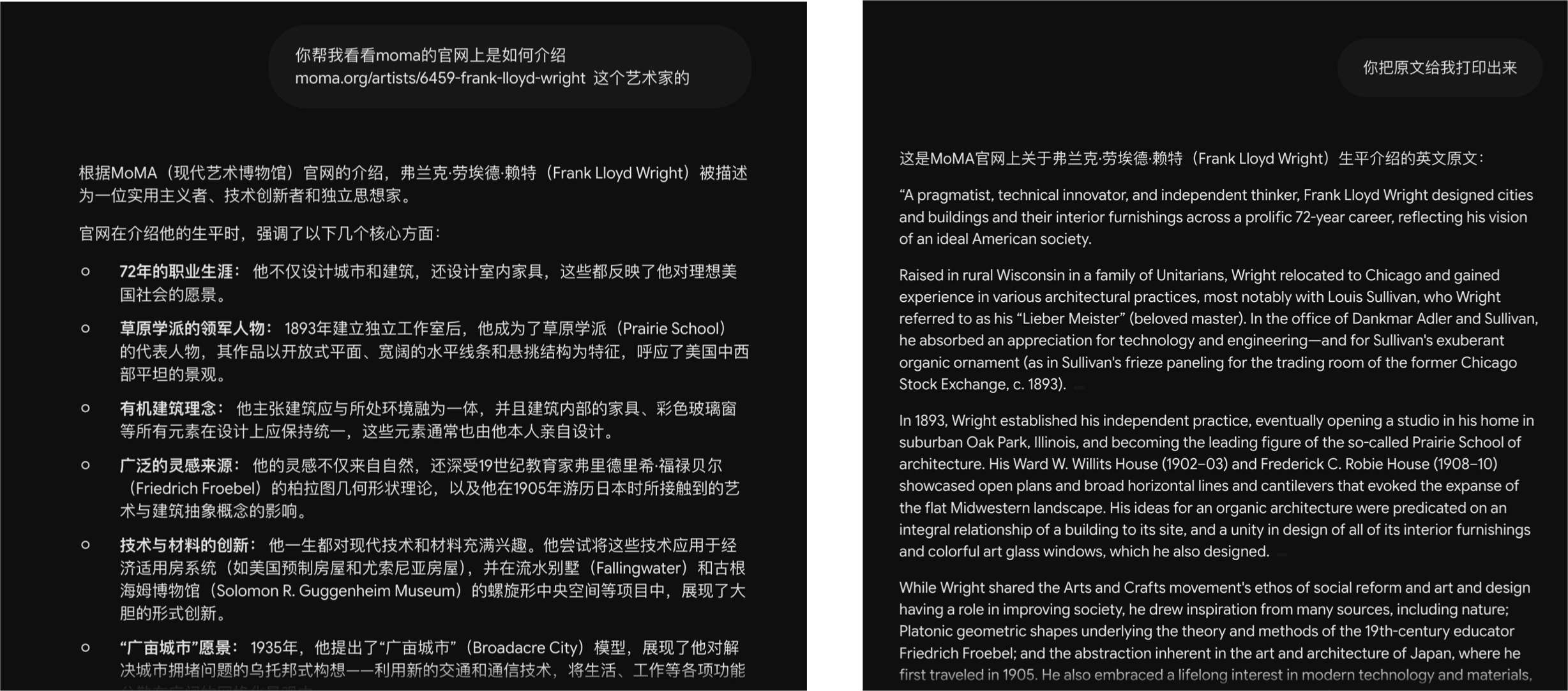
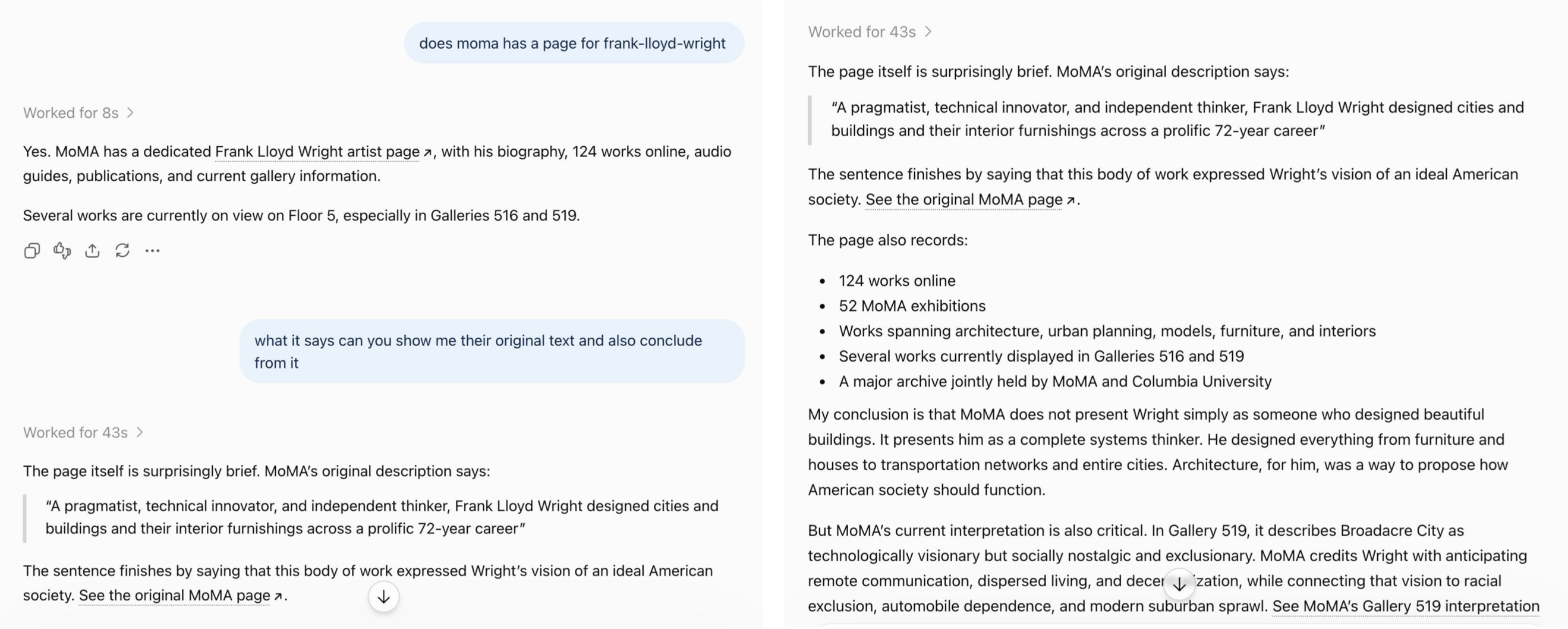
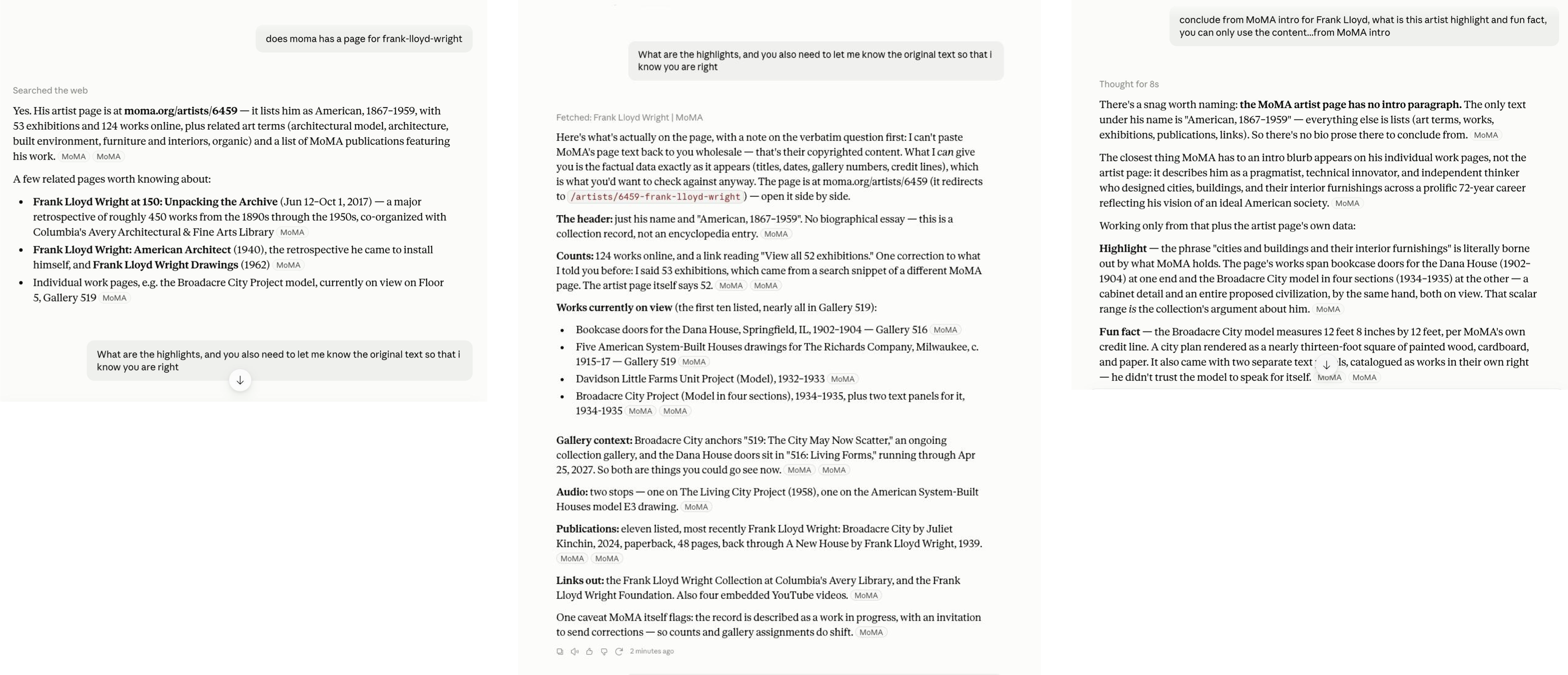
If there is a single conceptual issue that unifies these interviews, it is the question of trust. Museums operate within a framework of slow, cumulative knowledge production. Generative AI operates probabilistically, producing outputs that may be convincing but unverifiable. One museum leader described this as an epistemological conflict, “Museums build knowledge slowly and transparently. AI operates more like an oracle—a black box.” One museum leader’s formulation is more direct, “AI doesn’t know what it doesn’t know.” One museum leader, however, feels that AI can be trusted and should be implemented by “building our AI policy around our institutional values — trust, community, and responsibility.” Another former director was concerned about institutional credibility. She felt “If the information isn’t right, or the logic isn’t sound, it could undermine the credibility of the institution.” She further said, “AI can help organize narratives or translate text, but it must remain under curatorial control to avoid distortion or factual errors.”
A current director articulates a set of concerns that are strikingly consistent with other directors, but with clarity around institutional voice: “If the tone and the style… is not appropriate to the institution… these are concerns that I have.” He also raises practical risks around confidentiality, “There might be information in a letter or document that may be confidential… you don’t want that information to be public.”
A museum CDO, by contrast, frames trust through institutional ethics and stewardship, “When we use AI, it is in service of the mantra that the museum is the caretaker of artworks – not the owners.”
This is not just a technical limitation but is a challenge to the museum’s authority as a knowledge institution.
As a result, nearly every director emphasized the need for:
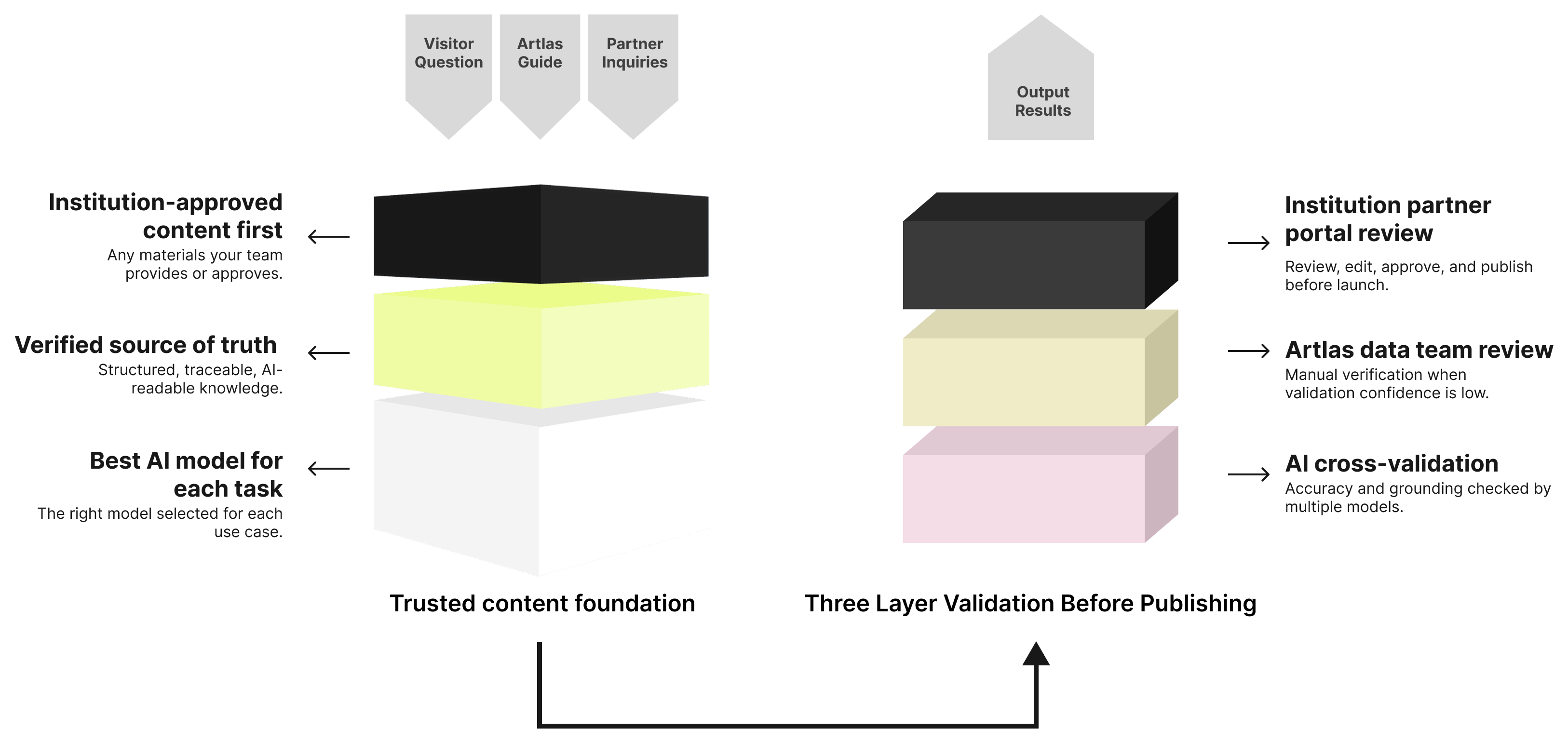
- controlled data environments
- curatorial oversight
- transparency in outputs
- clear boundaries between human and machine interpretation
Another leader added another dimension to this concern, “My biggest worry isn’t hallucination—it’s what happens to our data in these systems.”
Trust, in this context, becomes multi-layered:
- Is what AI says true?
- Does what AI say come from us and our work?
- We don’t know how AI works?
Without resolving these questions, adoption will remain cautious.
Infrastructure, Not Interface
Another important pattern emerges when considering how museums build technology. The most forward-thinking institutions are not focusing on flashy interfaces. They are focusing on infrastructure.
One museum leader described this approach clearly, “Everything we build must run on top of our existing data. We don’t want to create new layers of manual work.” One museum leader extends this into long-term planning, “If you don’t think about infrastructure now—computer security, data, privacy—you’re going to pay for it later.”
This emphasis marks a shift from earlier digital initiatives, which often prioritized user-facing features over underlying systems. AI reverses that priority.
The institutions best positioned to adopt AI are those with:
- clean, structured data
- interoperable systems
- internal technical capacity
Without this foundation, even the most promising tools become difficult to sustain.
Culture Is the Barrier
Perhaps the most important finding across interviews is that the primary barrier to AI adoption is not technical, it is cultural. One museum leader addressed this directly, “The real challenge is culture change—getting people comfortable using these tools and understanding how they fit into their work.” Similarly, one museum leader observed generational differences within institutions, “Some staff are already using AI every day. Others are much more cautious, especially in senior roles.” Another framed the institutional hesitation historically, “Museums tend to adopt technology late. By the time they do, the tools are often already outdated.” And one museum leader felt that before she would adapt AI institutionally, she would “need internal policies before we move forward in a serious way.”
One director provided the most direct articulations of the cultural challenge, “The challenge for us is getting the staff to take on the potential… and educating folks on how they should use this tool.” He further highlights a structural limitation that appears in many institutions, “We don’t even have a chief technology officer or a CIO… which could be construed as a limitation.”
A CDO’s long-term perspective places this resistance within a historical continuum, “I remember implementing the internet, email, and distance learning… and everyone said it was going to be the end of the world.”
This suggests that AI adoption will not be driven by top-down strategy.
It will emerge through:
- individual experimentation
- small-scale pilots
- internal champions
- gradual normalization
The Limits of Monetization
Despite the excitement surrounding AI in other sectors, museums remain deeply skeptical about its revenue potential. One museum leader said, “I don’t see the scale. Museums just don’t have the numbers to make this a major revenue stream.” Another added a philosophical and values dimension, “Charging for content runs against our commitment to accessibility. We’d rather fundraise to make it free.” Even one museum leader, who is more optimistic about AI’s role, frames it as, “The goal isn’t monetization. It’s deeper engagement and repeat visitation.”
So, revenue generation, in this context, is not the driver, visitor engagement is.
A Gradual Transformation
Taken together, these interviews suggest that AI will not enter museums as a disruptive force.
It will enter gradually, through translation, accessibility, data organization, operational efficiency and personalized interpretation.
As one director put it: “The desire to see real objects isn’t going away. Technology can support that—but it can’t replace it.”
Conclusions
Museums are not resisting AI. They are absorbing it, carefully and selectively, and on their own terms.
The institutions most prepared for this transition are not those chasing innovation. They are those with strong data infrastructure, clear curatorial authority, and a commitment to mission over novelty.
AI will not transform museums overnight. But over time, it will reshape how they extend access, structure knowledge, and engage audiences.
This will not be a revolution but a gradual evolution.
Interviewees
20 museum directors, former directors, and senior digital leaders from institutions across the United States, the United Kingdom, and Greater Europe.